Stress
Management and Health
Lesson
1
Introduction
to Stress and Stress Management
Reading
Assignment:
Chapter
1 in text
Chapter
16 in text
Read
pages 366-367 in text, the portion which discusses journaling and mindful
writing;
Read
lesson one and it's web resources
Lesson
Objectives or What You Need to Know for the midterm:
How
to best utilize these learning objectives:
These
learning objectives serve as a study guide of what you need to know from the
midterm. It is recommended that for each week's lesson, students make a
set of notes in which they address each objective, utilizing information
from the text, lesson, lesson links, and any other assigned reading..
Doing so, is a very good way to prepare for exams. It is important to keep up on
this each week as exams come fast in a 3 unit/ 8 week course.
1.)
Explain how it is that we are continually managing stress even if we are unaware
of it.
2.)
Who chooses our response to stressful situations?
3.)
Define and give examples of the following terms, stress, stressor, stress
underload, eustress, distress, acute stress, episodic acute stress, and chronic
stress.
4.)
What are symptoms of stress underload? of distress? of eustress?
5.)
What is the goal of stress management?
6.)
What determines whether something in our life is a stressor or a distressor
7.)
What factors make it more likely that a stressor will become a distressor?
8.)
Define, differentiate between, and give examples of acute stress, episodic acute
stress, and chronic stress. In addition, know how each of these effect a person.
9.)
Provide the old definition of health and the definition of holistic health.
10.)
Define and describe each of the dimensions of health discussed in the chapter.
11.)
Explain the interrelationship between stress and each of the dimensions of
health.
12.)
Explain the concept of journaling, list the benefits of journaling as discussed
in the text and article (lesson's web link).
13.)
Explain the history of journaling as discussed in the article.
14)
Define and discuss the importance of relaxation and important points to keep in
mind as you practice relaxation exercises (all found in text).
15.)
List and explain the benefits of relaxation.
16.)
Discuss tips for getting started with relaxation exercises and the importance of
using good judgment when practicing relaxation exercises.
Hello Class,
first I would like to begin by telling you how excited I am about teaching this
class. It is not uncommon to take a college class and never utilize the
information you worked so hard to master. This obviously is not one of those
classes. Each and every one of us experiences stress. Furthermore, each of us
manages that stress on a day in and day out basis.
Now you may be thinking that you are not managing your stress at all. In reality
we are all managing our stress, sometimes we manage it effectively and in a
positive manner, and sometimes we manage it ineffectively and in a negative
manner.
|
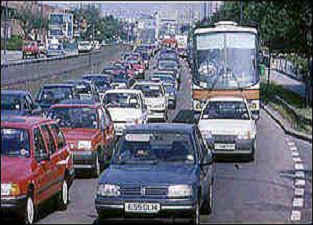
Think for a moment of
the common stressors you face as a college student? As a member of your
family? On the job? Even just driving in traffic?
Now think of how you cope with those stressors. Let’s take
traffic. You are running late to a very important appointment, you get on
1-80 and boom, it just stops. There is nothing you can do, you are sunk.
You are going to be late. You
will manage that stress whether you do so consciously or unconsciously.
Some of you will say to yourselves,
“
There is nothing I can do about this, I may as well take a deep breath,
sit back, and listen to some relaxing music.”
Others
will feel their blood rush, their heart rate increase, and become agitated
and/or angry. Some will fume and fret and even begin uttering a vast array
of expletives.
Some
will begin weaving in and out of different lanes, cutting others off, and
communicating with other drivers with hand gestures.
Others
will see it as an opportunity to get on their cell phone and text a
friend, possible causing another accident..
Whatever
response one chooses, (and we do hold the power to choose our response),
he/she is utilizing coping mechanisms to manage the stressful situation.
Some of those coping mechanisms are effective and health enhancing,
others constitute a less healthy means of coping with stress. Some coping
methods may even cause self-harm, harm to others, or both.
In
this scenario, we have no power over how others respond or react, we only
have power over how we respond. We can get as angry or stressed as we
choose, the negative consequences will likely affect only us.
How
will you choose to respond?
|
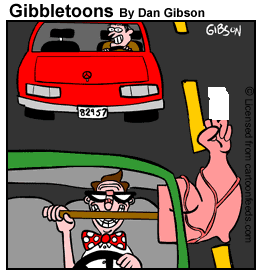
Portions of the picture above
have been deleted by the professor to reduce offensiveness
|
Stress,
Stressors, and Distress
So what exactly is stress?
There are many different definitions, for sake of simplicity, in this class we
will use the definition in the text. The text defines stress as "a
demand made upon the adaptive capacities of the mind and body." I define it
in a similar fashion, Stress is the arousal of the mind and body in response to
the demands placed upon it. A stressor then is any stimulus or demand
placed on mind or body. The text defines a stressor as "any event or
situation that an individual perceives as a threat that causes us to either
adapt or initiate the stress response. Stressors are ever-present in our daily
lives. The goal of stress management is not to eliminate stressors from our
life, it is impossible to do so.
It is important to point
out that stress is not a bad thing or something that should always be avoided.
Quite the contrary, too little stress can lead to psychological and physical
problems just as too much stress can. When we have too little stress, a
state of stress underload, we have no challenge in our life, we have
nothing exciting we are working towards. For example, perhaps you know of
someone from high school, who upon graduating from high school did not get a job
or go to school, rather he/she decided to stay living with their parents and
just goof-off for a few years. It appears the person has it made, they are
living for free, they do not have to work, go to school or anything. How could
they be so lucky? At first the person is having fun enjoying their
responsibility-free, goal-free lifestyle. Overtime however, if this person
continues to have nothing in life to work towards, or anything that he/she finds
stimulating, he/she will get increasingly negative, complacent, apathetic, and even possibly
depressed. Mental faculties will actually grow dull, physical energy
levels will decline as well. He/She will actually develop some of the symptoms of
stress overload.
What we really need is an
ideal level of stress in our lives. The Yerkes-Dodson Principle explains
a certain amount of stress in our lives is healthy and beneficial. Hopefully we all have
positive stressors in our lives. Positive stress or eustress occurs
when we perceive stressors as positive and challenging. Examples of positive
stressors might be working towards college graduation, beginning a new job, or
training for and competing in an athletic event. Perhaps one has a goal that
will require that he/she grow and learn. The stressor is not overwhelming,
rather it is exciting and one feels motivated and enthused by the challenge, it
gets one's blood pumping. When an activity provides a healthy amount of
stress we perform at our personal best, we are "in the zone", our
mental faculties are sharp, we make decisions quickly, our recall is quick and
accurate, our body can rise to the physical challenge if necessary. This healthy
amount of stress sharpens our performance. We know we have the ability to
succeed but will need to be at our best in order to do so. This is a
healthy amount of stress. It is my hope that this is the level and type of
stressors you are experiencing in your life. If a negative event occurs and we
handle it positively and effectively and we are not distressed by it, such
stress can fall into the category of eustress also.
Unfortunately however,
life's stressors sometimes become overwhelming. When this occurs we are no
longer "in the zone." The stress in our life has exceeded our
ability to cope effectively, we are on stress overload. Our physical, mental,
and emotional performance becomes compromised. We have increasing difficulty
focusing on the task at hand, thinking clearly, recalling information, and
making effective decisions. Our mind is too overwhelmed for clear thinking
and concentration. When on stress overload one's health may decline as
well, resulting in any of a long list of physical problems. Furthermore, we
typically become edgy, grumpy, and may even lash out at others. We are in a
state of distress. Distress is defined as too much or too little demand
on mind or body resulting in harm to mind or body. When we are talking
about being "stressed out" we are really saying we are in a state of
distress.
The goal of effective
stress management therefore is to keep stressors from becoming distressors.
Sometimes gaining understanding and awareness of certain stressors can keep them
from becoming distressors. Typically, if we perceive a stressor as
predictable and manageable it perceived as less threating.
|
Stressors
vs. Distressors
The goal of stress management is
not to eliminate stress from our lives, rather it is to learn to reduce
distress. It is important to realize that stressors do not cause harmful
effects, rather harmful effects result from our personal interpretation of
life's demands and stressors. Stressors are not harmful if we
refrain from converting them into distressors. Stressors only become
harmful when we convert them into distressors. Typically something becomes
a distressor when 1.) Our personal well-being is threatened, this may be
actual physical, psychological threats to our well-being which we need to
change to keep ourselves safe, or it may be something we perceive as
threatening which actually is not. or... 2.) We perceive a stressor
as exceeding our resources and/or ability to cope. or... 3.) We perceive
the stressor as unpredictable thus causing us to view it as more
threatening. |
Stressors
are not harmful if we refrain from converting them into distressors
Symptoms
of Distress
Trembling
Hands Stomach Churning
Tight
Shoulders Sore Lower Back
Edginess
Anxiety Depression
Irritability
Short-Temperedness
Poor
Concentration Fuzzy Thinking |
Once again, the goal of effective
stress management therefore is to keep stressors from becoming distressors.
Sometimes gaining understanding and awareness of certain stressors can keep them
from becoming distressors. Typically, if we perceive a stressor as
predictable and manageable it perceived as less threatening.
Acute
and Chronic Stress
Go to chapter 1 in text in
order to define, differentiate between, and give examples of acute stress,
episodic acute stress, and chronic stress. In addition, know the consequences of
each of these in our lives.
Holistic
Health and the Dimensions of Health
Prior to the 1900's health
was defined as "the absence of disease." Because infectious
disease and disease due to contaminated water and food were so prevalent, a
person was considered healthy if they were disease free. Infectious disease was
also the leading cause of death. With modern advancements such as vaccines,
antibiotics, food standards, and clean drinking water supplies, infectious
disease is no longer among the leading causes of death. As a result of
these changes, the definition of health has also changed.
Today health is
defined holistically. Holistic health consists several dimensions
of health. These dimensions of health include physical, intellectual, emotional, spiritual, social, and
environmental health (the text does not include the environmental dimension but
it has been recently added as a dimension of health). We are encouraged to find balance in these various
dimensions of health. When we are on stress overload or frequently distressed,
our health will likely suffer in any or all of these dimensions of health. Likewise, imbalance in
any of these dimensions can increase stress and cause problems in the other
dimensions.
In your text read about
holistic health and the dimensions of health with the objectives of
differentiating between the old definition of health and the new
definition of health, defining and describing the 5 dimensions of health
discussed, and explaining the relationship between each dimension of health and
stress.
Stress
Management Activities in This Course:
Each week, in this course,
we will have a stress management activity of the week. This is the part of the
course where we put the rubber to the road. It is great to read about and
discuss stress management, but one can only benefit by actually practicing
stress management techniques. Thus, in this course, practicing the various stress
management activities is of vital importance. This course can give you a great
deal of information, however the only way to benefit is to practice stress
management. In this course we will practice a wide variety of stress management
activities. You will find that some of these work well for you while others do
not. This is quite normal, we are all different and different things work
for different people. In addition, different things may work better for
different situations. I ask that you try all of the techniques, really
give them a chance and see what works best for you. Learning stress management
is partially a journey of self-discovery.
Also, please be aware that
it takes time to master these various stress management activities, it takes far
more time than we have in this short class. For example, one of the stress
management activities is to practice progressive muscle relaxation, another
week's activity is to practice meditation. In order to really get good at either
of these, one typically practices them for months, even years. The more one
practices relaxing mind and/or body, the better one becomes at it, but it takes
time, a lot of time.
In order to gain maximum
benefit from these stress management activities I highly recommended that each
of you create a quiet, comfortable place in which to do them. A place that is
free of distractions, a place that is very relaxing. This may be a small corner
of the house or apartment, nevertheless it is set aside for relaxation
only. One can place anything in this space that might enhance relaxation,
a pretty vase, flowers, religious images or pictures, candles, whatever
works. The space should have a comfortable chair or cushion on which to
sit and do the relaxation exercises. Relaxation and stress management exercises
in this course should not be done lying down as their purpose is to relax during
the day, not fall asleep. The goal is to learn to bring them into one's everyday
activities. To learn to do this, one must learn to use them awake, not to fall
asleep.
Overtime, if one continues
to practice stress management and/or relaxation exercises on a regular basis,
one typically learns to do so in other places in everyday life. For beginners it
is best to start relaxing in a special quiet place, with time one learns to
relax his/herself in other places and situations.
Stress
Management Activity of the Week: Making a Quiet Place, and Journaling
The first part of this
week's stress management activity is to create a quiet space in your home or
wherever. A place where you feel comfortable, that you enjoy, where you can
relax, and be free of distraction. It is important that you be sitting and not
lying down. You will be describing your quiet place in a subsequent quiz in this
course.
Journaling
is a technique that has been used by successful people throughout the ages. When
one journals it is best to let the mind and pen run free, to express what is on
one's mind, be it a creative idea, negative emotions, or a decision making
process. If there is a problem running around in one's mind that he/she cannot
let go of, journaling can often help. Journaling can also help one release
negative emotions and thus see a problem more clearly, it often leads to
creative problem solving. A journal can be like a personal friend, a
confidant. It has been shown through scientific study that journaling can
improve physical health and help people manage stress. Read the following
article about journaling, it discusses benefits of journaling as well as
techniques to get you started. Also read about journaling in and mindful
writing on pages 366-367 in your text.
http://psychcentral.com/lib/2006/the-health-benefits-of-journaling/